
Every June, Pride Month invites us to celebrate diversity, visibility, and the freedom to be ourselves. Yet for many people, conversations about the LGBTQ+ community can feel overwhelming. New terms seem to appear every year, and it can be difficult to understand what they all mean.
But these labels are more than just words.
For many LGBTQ+ individuals, labels provide a way to describe experiences that may have felt confusing or invisible for years. They help people better understand themselves, find communities where they belong, and communicate their identities to others. At the same time, learning these terms can help foster respect, empathy, and meaningful conversations.
Whether you’re a member of the LGBTQ+ community, an ally, or simply curious to learn more, understanding these identities is one small step toward creating a more inclusive world. Here’s a beginner-friendly guide to some of the most commonly used LGBTQ+ terms and what they mean.
What Does LGBTQ+ Mean?
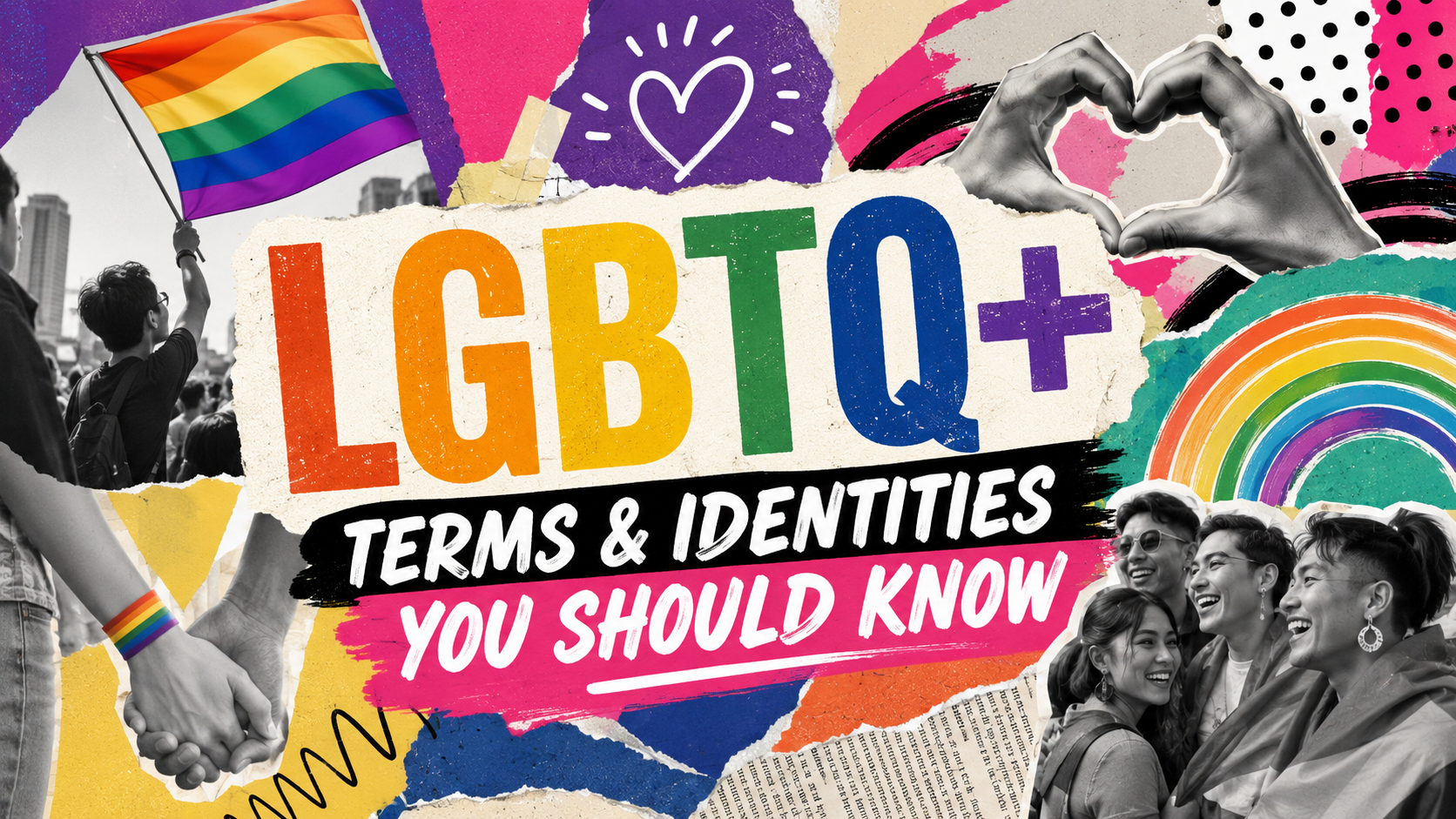
LGBTQ+ is an umbrella term that includes people of different sexual orientations and gender identities. The letters commonly stand for Lesbian, Gay, Bisexual, Transgender, and Queer or Questioning, while the plus sign represents many other identities such as intersex, asexual, pansexual, nonbinary, and more.
Filipinos may also encounter the term SOGIE, which stands for Sexual Orientation, Gender Identity, and Gender Expression. It’s commonly discussed in schools, workplaces, and public conversations about diversity and inclusion. Simply put, SOGIE recognizes that every person has their own sexual orientation, gender identity, and way of expressing themselves, whether they identify as LGBTQ+ or not.
Many aspects of identity exist on a spectrum rather than fitting neatly into a single category, which is why language continues to evolve alongside people’s experiences.
Understanding Sexual Orientations
Sexual orientation refers to a person’s enduring emotional, romantic, and/or physical attraction to others.
- Lesbian describes a woman who is emotionally, romantically, or physically attracted to other women.
- Gay refers to a person who is attracted to people of the same gender. Although often associated with men, the term may also be used by women and some nonbinary individuals.
- Bisexual describes a person who is attracted to both men and women. A person does not need previous romantic or sexual experience to identify as bisexual.
- Pansexual refers to someone who may be attracted to people of any gender or gender identity. For many pansexual individuals, gender is not the determining factor in attraction.
- Polysexual describes people who are attracted to multiple genders, but not necessarily all genders.
- Asexual, sometimes shortened to “ace,” describes a person who experiences little or no sexual attraction. This differs from celibacy, which is a personal choice to abstain from sexual activity.
- Graysexual individuals experience sexual attraction infrequently or at a lower intensity than most people.
- Demisexual people typically experience sexual attraction only after developing a strong emotional connection with someone.
- Aromantic individuals rarely or never experience romantic attraction, although they may still form deep emotional bonds and experience other types of attraction.
Understanding Gender Identity
Gender identity is a person’s internal sense of being male, female, both, neither, or something beyond traditional gender categories. It is distinct from a person’s sex assigned at birth.
- Cisgender describes people whose gender identity matches the sex they were assigned at birth.
- Transgender refers to people whose gender identity differs from the sex assigned to them at birth.
- Transgender Woman (or Trans Woman) is a person who was assigned male at birth but identifies as female. Some trans women actively identify as transgender, while others may simply identify as women.
- Transgender Man (or Trans Man) is a person who was assigned female at birth but identifies as male. Some trans men actively identify as transgender, while others may simply identify as men.
- Nonbinary or Enby (phonetic) is an umbrella term for people whose gender identity exists outside the traditional male-female binary.
- Agender people may identify as having no gender at all or as being gender-neutral.
- Bigender individuals identify with two genders, either simultaneously or at different points in time.
- Gender-fluid people experience changes in their gender identity, gender expression, or both over time.
- Gender-neutral individuals may not identify with a particular gender and often choose not to conform to traditional gender expectations.
Other Important LGBTQ+ Terms
- Intersex refers to people born with physical sex characteristics, chromosomes, hormones, or reproductive anatomy that do not fit typical definitions of male or female bodies. The “I” in LGBTQIA+ stands for intersex.
- Queer is a broad umbrella term used by some people whose sexual orientation or gender identity falls outside heterosexual and cisgender norms. While it was once used as a slur, many members of the LGBTQ+ community have reclaimed it as a positive identity.
- Questioning describes individuals who are still exploring or discovering their sexual orientation, gender identity, or gender expression.
- Closeted (or “in the closet”) describes a person who has not publicly shared their sexual orientation or gender identity. Some people may be closeted to everyone, while others may be open with close friends but not with family, classmates, or coworkers.
- Discreet is a term sometimes used by LGBTQ+ individuals who prefer to keep their sexual orientation or gender identity private. People may choose to be discreet for many reasons, including personal preference, cultural expectations, privacy concerns, or concerns about discrimination.
- WLW, short for Women-Loving-Women, is an inclusive term that encompasses women who are romantically, emotionally, or physically attracted to other women, including lesbians, bisexual women, pansexual women, and queer women.
- Two-Spirit is a culturally specific identity used by some Indigenous Native American communities. While definitions vary among tribes, the term can encompass gender, spirituality, and sexuality, and has existed in Indigenous cultures for centuries.
More Than Labels
Not everyone chooses to use a label, and that’s okay. Some people proudly embrace labels, while others may still be questioning, closeted, or prefer to keep their identity private. Every journey is unique.
What matters is understanding that these labels can help people feel seen, understood, and connected to a community. This Pride Month 2026, you don’t need to memorize every term. Simply lead with respect, empathy, and a willingness to learn. After all, Pride is about giving everyone the freedom to be themselves.
References:
- LGBTQ+ Definitions, Terms and Concepts – https://www.aecf.org/blog/lgbtq-definitions
- LGBTQIA+ Glossary – https://lgbtq.ucsf.edu/glossary-terms
- The Basics of LGBTQ – https://www.youtube.com/watch?v=YYTij4ai0kY

Ronnie Yatco
Ronnie is a portrait and editorial photographer, a coffee and sushi-lover, a dog-dad, a fitness enthusiast, an interior design hobbyist, and a budding theater actor. Follow him on IG @znackefronn